


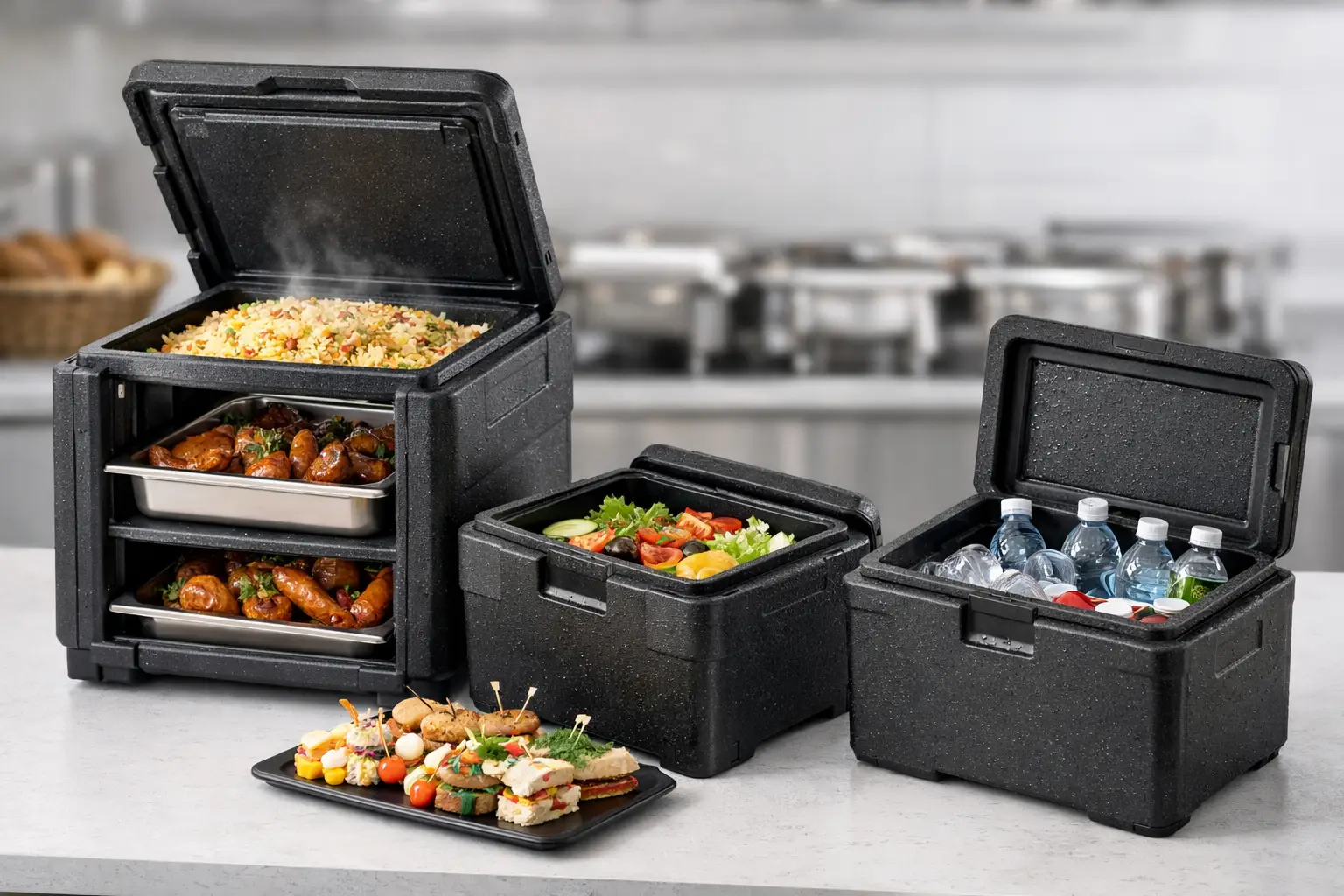
The difference between a perfectly executed event and a delivery with complaints often isn’t found in the menu, but in the serving temperature. That’s precisely where insulated containers for catering become critical equipment. For a HoReCa professional, they are not just transport containers. They are a means of maintaining quality, hygiene, and operational consistency from the kitchen to the point of consumption.
In catering services, food transport has two constant requirements: temperature control and durability for continuous use. When the load includes ready meals, GN pans, dishes with hot food, or cold preparations, the transport container must protect the contents from thermal loss, impacts, and cross-contamination. The wrong choice usually costs more than purchasing the correct product – in returns, delays, and damage to reputation.
Why Insulated Containers for Catering are Essential Equipment
Their basic function is obvious: they keep hot food hot and cold food cold for a specific period. In practice, however, their value is broader. They help stabilize the distribution process, reduce operational risk, and support better organization of loading and deliveries.
In catering with multiple service points, the right insulated solution provides predictability. The team knows how many dishes each unit holds, how easily it loads into the vehicle, and how well it withstands repeated opening and closing. This consistency is particularly important when service must adhere to strict schedules.
There is also the hygiene parameter. A professional insulated container is constructed to be easily cleaned, not retain odors, and withstand frequent washing. For food businesses, this is not an additional advantage but a basic specification.
How to Choose Insulated Containers for Catering
The correct choice begins with the application, not general capacity. A business transporting individual small-scale orders has different needs than an organized catering service working with large volumes in gastronorm pans.
Capacity and Dimensions
The first question is what exactly you will be transporting. If daily use involves GN 1/1, GN 1/2, or trays of specific dimensions, the container must be compatible with these loads without improvised adaptations. The internal layout affects both thermal performance and loading speed.
Excessively large capacity is not always an advantage. If the container travels half-empty, efficiency may decrease, and movement may become more difficult. On the other hand, a very small container increases the number of routes or pieces of equipment the team needs to manage.
Temperature Retention
It is not enough for a product to be labeled as insulated. It is necessary to examine how well it retains hot or cold contents under actual operating conditions. Transport duration, frequent stops, external temperature, and how often the lid is opened play a significant role.
For short urban routes, a typical solution may be sufficient. For out-of-town events, longer distances, or outdoor events with high temperatures, increased insulation and a more robust construction are needed. In such cases, you are not just buying capacity but operational security.
Construction Material and Durability
In professional use, insulated containers are subjected to daily wear and tear. They are loaded and unloaded from vehicles, dragged across event venues, washed frequently, and come into contact with loads of varying weights. The durability of the material is crucial for their lifespan.
Models made from durable polymer materials are of great interest for catering, as they combine relatively low weight with good mechanical strength. At the same time, it is important to check the quality of hinges, latches, handles, and points that receive the most stress. This is usually where the true quality of construction is revealed.
Hygiene and Food Suitability
For professional food use, the suitability of materials is non-negotiable. Surfaces must be effectively cleaned, have no difficult areas that trap residues, and withstand the cleaning agents used in daily operation.
Additionally, it is worth considering whether the design allows for quick drainage and drying after cleaning. In environments with a fast usage cycle, this reduces downtime and helps maintain consistent hygiene standards.
Practical Criteria Affecting Daily Operations
Technical specifications are the foundation, but daily efficiency is often determined by more practical details. The weight when full, ease of transport by one person, stackability, and compatibility with trolleys or loading racks make a real difference.
If the business manages multiple events on the same day, stacking saves space in the vehicle and in storage. If containers are frequently moved long distances within hotels, conference centers, or reception venues, ergonomic handles and stability during transport become particularly important.
It is also useful to consider the speed of access to the contents. In time-sensitive service, a lid that opens easily but seals correctly is more helpful than a theoretically robust system that delays the team. The right balance is always a matter of application.
Common Mistakes in Purchasing Insulated Equipment
The most common mistake is choosing based solely on the lowest price. At first glance, this seems logical, especially when the business is procuring multiple units. In practice, however, a cheap product with poor insulation or weak closing points leads to quick replacement and increased operating costs.
A second common mistake is the inadequate matching of the container to the type of load. Not all businesses have the same needs. Transporting individual portions is different from transporting large pans, and different again from using them for baked goods or cold preparations. When the product has not been selected for the specific workflow, it creates friction at every stage.
There is also the mistake of underestimating cleaning. If the container is not easy to wash, the team will spend more time on maintenance or, worse, residues and odors will remain. In a professional food environment, this is a serious operational issue.
When to Invest in a Heavy-Duty Solution
Not all businesses need the same category of equipment. If catering serves a small number of deliveries within a short radius, a reliable basic solution can fully cover the needs. However, when distances, volumes, or frequency of use increase, more reinforced insulated containers quickly pay for themselves.
This is especially true for businesses operating daily, with multiple loading cycles and intense seasonal pressure. In such conditions, greater durability, better insulation, and easier management reduce wear and tear, temperature loss, and delays. Simply put, the investment is not just about the product but the stability of the service.
This is why a supplier with a professional application mindset, like Pack Markt, is valuable when they can connect the product to actual usage conditions and not just a general category description. The right equipment is chosen based on the load, frequency, usage environment, and hygiene requirements.
What to Keep as a Purchase Criterion
If you need to distinguish the essentials, focus on four elements: thermal performance, durability, hygiene, and ergonomics. The right insulated solution for catering is not just one that holds food, but one that delivers it in the correct condition, without burdening the team’s operations.
The best choice is usually not the most impressive on paper. It is the one that fits your workflow, the dishes you already use, the distances you cover, and the intensity level of daily use. When the container works correctly in the background, the business can focus on what matters most: consistent delivery quality, in every service.
Leave a comment
Your email address will not be published. Required fields are marked *