


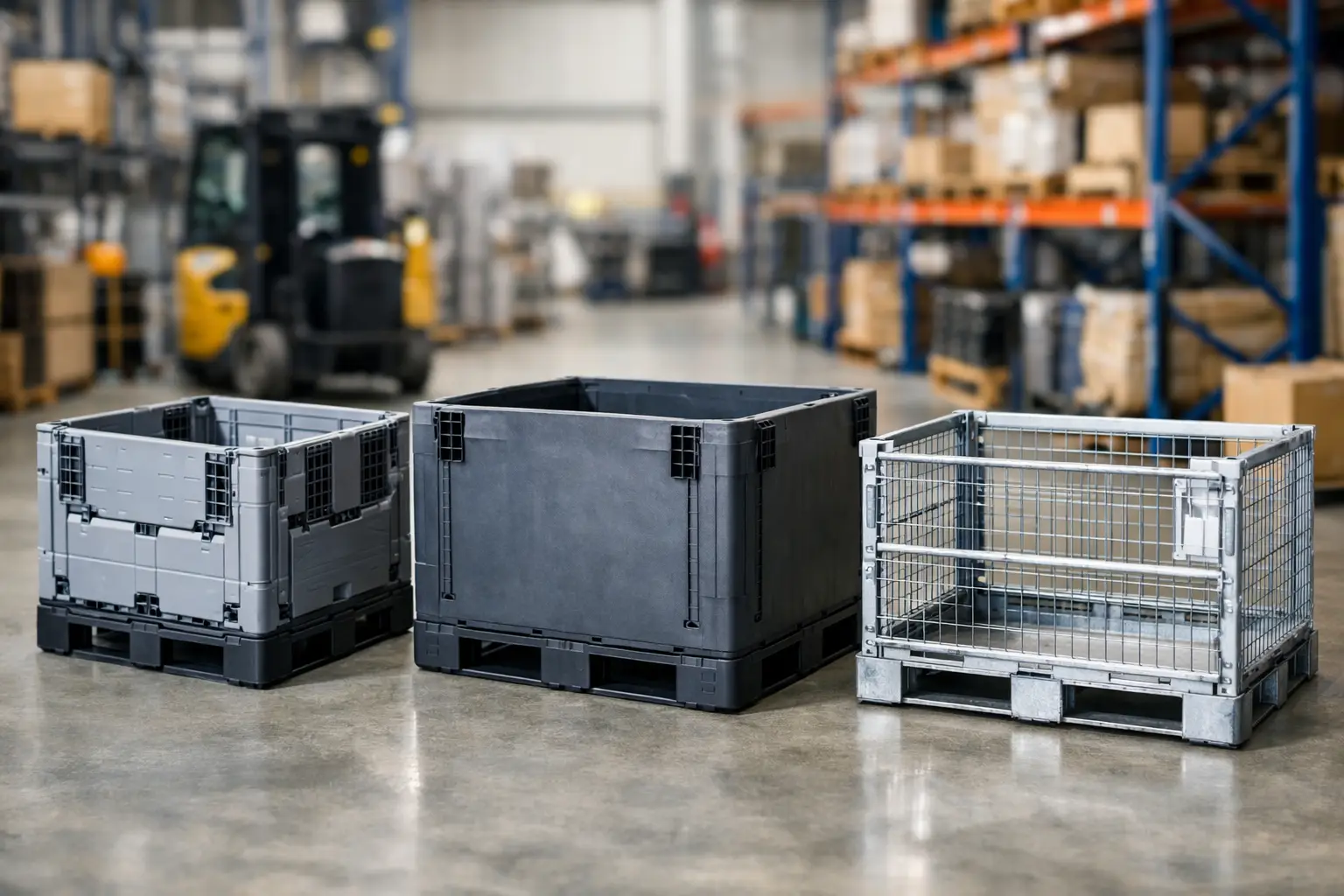
When a pallet box fails, the cost is not only reflected in the wear and tear of the equipment itself. It manifests in delays, product losses, cleaning difficulties, inefficient space utilization, and increased handling risks. Therefore, a proper industrial pallet box selection guide does not start with price, but with usage, load, and operating conditions.
The pallet box is an essential tool for storage, internal handling, and product protection in industry, food, logistics, recycling, and agri-food applications. There is no one-size-fits-all solution. The correct model depends on whether you are transporting raw materials, finished products, bulk materials, liquids in an inner liner bag, or components that require clean and organized stacking.
Industrial Pallet Box Selection Guide with the Right Criteria
The first question is simple: what exactly will go inside? A pallet box for food has different requirements than one for heavy industrial components or for collecting production waste. The weight of the contents, volume, product sensitivity, and cleaning needs determine the choice much more than a general description like “heavy-duty.”
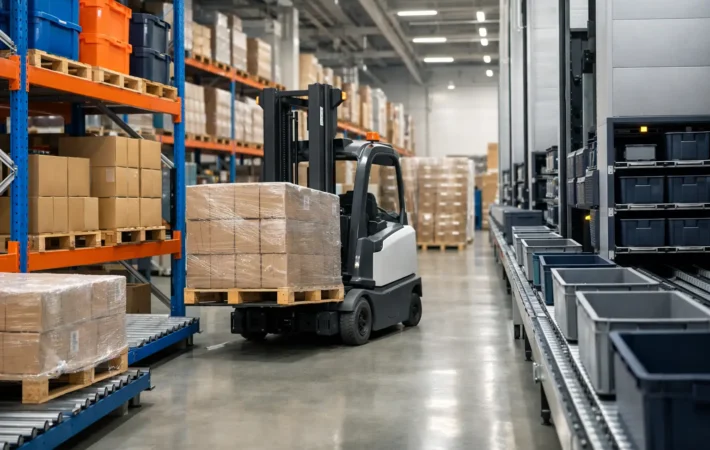
Equally important is the pallet box’s journey within your operation. Will it primarily remain in static storage or will it be moved daily on shelves? Will it be transported by pallet truck, forklift, or automated system? Will it travel loaded between facilities or be used only internally? The same construction can perform excellently in one setup and prove unsuitable in another.
Construction Material and Durability in Real-World Use
In industrial practice, the construction material is one of the first selection filters. Plastic pallet boxes dominate most professional applications because they combine durability, lower weight, ease of washing, and good performance in humidity. For areas requiring hygiene, consistent quality, and repeated use, they are usually the safest choice.
However, it is not enough to know that it is “plastic.” You need to examine its structure, wall thickness, base reinforcement, and impact resistance. In facilities with low temperatures or intense daily handling, real mechanical strength makes the difference. An economical model may seem adequate for light use but may show cracks or deformations when frequently loaded or stacked high.
If the application involves food, beverages, or raw materials with hygiene requirements, the suitability of the material must be clear. A general approach is not sufficient here. You need surfaces that can be properly cleaned, do not easily retain residues, and support consistent hygiene procedures.
Solid or Perforated Pallet Box
The choice between solid and perforated walls is not an aesthetic matter. Solid pallet boxes are generally preferred when you want protection from dust, retention of smaller materials, or better control over cleanliness. They are suitable for industrial components, food, packaged products, and applications where the contents should not be exposed.
Perforated models serve a different need. They allow ventilation and drainage, which is useful for fresh produce, washing materials, or environments where moisture needs to be removed. The trade-off is that they offer less isolation from dust or micro-particles.
Feet, Skids, or Wheels
The base of the pallet box directly affects how it is handled. Models with feet are suitable for basic handling with forklifts, while bases with skids often provide better stability during transport and stacking. In some applications, the option with wheels improves ergonomics, but it is not always suitable for heavy loads or environments requiring secure stacking.
If you use automation or specific warehouse systems, the geometry of the base must be compatible with the equipment. Small incompatibilities here create recurring problems on the line.
Dimensions, Capacity, and Space Utilization
A common mistake in selection is to consider only the capacity in liters. In industry, compatibility with pallets, shelving, trucks, and available floor space is equally important. The correct pallet box must utilize space without hindering loading, retrieval, or access to contents.
External dimensions determine how many units fit per location, per level, and per vehicle. Internal dimensions indicate whether the product sits correctly inside the box or if useful volume is lost. For components with a fixed footprint, the correct internal dimension can significantly reduce gaps and the need for additional dividers.
Stacking requires special attention. Static load resistance is different from dynamic load resistance during transport. If you stack high in the warehouse, request actual strength data, not just general indications. The contents also play a role. A uniform load behaves differently from an uneven or point-heavy load.
Load, Weight, and Transport Conditions
The nominal strength of a pallet box must be considered in conjunction with its usage conditions. For example, a product may withstand a high load on a flat floor, but a lower load when frequently moved by a forklift or when stacked for extended periods. If the environment involves vibrations, ramps, uneven floors, or significant temperature changes, the theoretical strength alone is not sufficient.
For applications involving heavy metal components, spare parts, or bulk raw materials, it is worth examining the base’s behavior under actual load. Deformation may not be immediately visible, but it affects stability, stackability, and lifespan. Conversely, for lighter products, it might make more sense to prioritize ergonomics, cleaning, or space-saving when empty.
Hygiene, Cleaning, and Industry Suitability
For businesses in food, beverage, pharmaceutical excipients, or sensitive raw materials, ease of cleaning is not a secondary feature. It is part of the compliance process. Smooth surfaces, closed corners that do not retain residues, and materials suitable for professional use help reduce operational risk.
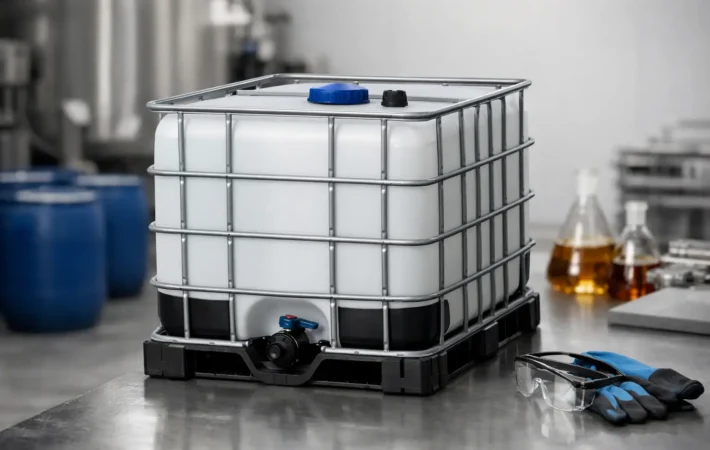
In a chemical or industrial environment, the criteria shift. Here, you would primarily consider chemical resistance, handling safety, and whether the pallet box will be exposed to oils, cleaning agents, solvents, or other aggressive factors. Not all plastics are suitable for every substance or temperature range, so the application must be clearly defined from the outset.
Collapsible or Fixed Pallet Box
This dilemma is primarily functional and economic. Fixed pallet boxes typically offer high rigidity and are very reliable in intensive, daily use. If the box remains constantly in circulation within production or the warehouse, a fixed construction often has an advantage.
Collapsible models gain an advantage when there is a need to return empty containers, save space, or for seasonal use. They reduce storage volume when not in use, but you need to check the strength of the walls, the folding mechanisms, and their behavior under repeated use. If usage is heavy and continuous, the space-saving benefit must be weighed against long-term durability.
What to Check Before Ordering
A practical guide to selecting an industrial pallet box always comes down to the technical details that must be confirmed before purchase. Request clear information on external and internal dimensions, capacity, box weight, maximum load, stackability, base type, and suitability for use. If there are requirements for food contact, specific environments, or particular cleaning procedures, these must be declared from the outset.
It is also useful to consider whether the pallet box integrates into a broader material flow logic. That is, if it works correctly with pallets, crates, bins, trolleys, or other equipment you already use. A correct choice does not just solve a single storage need. It improves overall handling, reduces damage, and makes daily operations more stable.
In an organized procurement environment, such as that served by Pack Markt, the correct selection of a pallet box is not a simple product purchase. It is a decision about operational efficiency. The clearer you define the load, the industry of use, hygiene requirements, and handling method, the easier it will be to arrive at a solution that performs in practice, not just on the technical data sheet.
The right pallet box does not stand out when new. It stands out after months of use, when it continues to safely support your business’s flow.
Leave a comment
Your email address will not be published. Required fields are marked *