


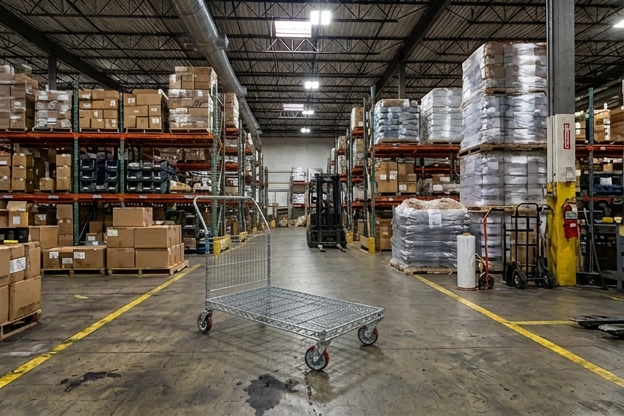
In the warehouse, on the production line, or in the back of a store, the wrong cart is immediately apparent. It buckles under the load, makes handling difficult, wears out prematurely, and ultimately increases time, fatigue, and risk. Heavy-duty metal transport carts are chosen precisely to avoid these problems when daily internal logistics require stability, high durability, and the safe transport of bulky or heavy materials.
For a professional buyer, the goal is not merely to move items from point A to point B. The goal is to reduce staff strain, protect the load, maintain workflow, and avoid failures that cost more than the initial savings of a cheaper option. In this context, the right metal cart is functional equipment, not an auxiliary accessory.
Where Heavy-Duty Metal Transport Carts Are Used
Their use is widespread, but not generic. In warehouses and logistics centers, they facilitate the movement of boxes, crates, packaged products, and raw materials between receiving, picking, and shipping zones. In industrial and manufacturing units, they transport components, tools, semi-finished products, or heavy consumables more safely than a light wheeled trolley.
In the food and beverage sector, selection is not based solely on weight. Ease of cleaning, material behavior in humid environments, and load stability in daily use are crucial. In HoReCa units and retail, these carts support the supply of warehouses, cold rooms, points of sale, and receiving areas, especially when loads are repetitive rather than occasional.
What changes from application to application is the actual requirement. A space with narrow aisles and many turns needs a different cart than an industrial unit where maximum durability and the transport of large loads over more open routes are paramount.
What Distinguishes Heavy-Duty Metal Transport Carts
The first element is the frame. The metal construction offers higher load capacity, better rigidity, and greater resistance to repeated stress. This is practically significant when the cart is used many times during a shift, consistently loaded near its limit, or moved on floors that are not perfectly smooth.
The second is the quality of the wheels. A strong frame without suitable wheels does not perform. The diameter, rolling material, bearings, and mounting type directly affect ease of handling, shock absorption, and the cart’s behavior under load. In many cases, the correct wheel selection improves daily use more than a theoretically higher frame strength.
The third is the configuration. A platform, side walls, folding parts, reinforced handles, or multiple loading levels completely change the product’s suitability. There isn’t one cart that covers everything. There is the right construction for the specific workflow.
How to Choose Correctly
The correct choice starts with the actual load, not the theoretical maximum. If you frequently transport 400 kg, a cart with a nominal capacity of 400 kg is not enough. A safety margin is needed, especially when the load is not ideally distributed or when there are vibrations, ramps, and sudden stops. Continuous use near the limit reduces equipment lifespan.
Next, consider the dimensions of the load. A deck that is too small does not properly support packages or boxes, while an excessively large platform can make maneuvering difficult. For warehouses with narrow passages, length and turning radius are as important as capacity.
The floor is also a critical criterion. Smooth industrial surfaces, ramps, joints, outdoor areas, or mixed routes require different wheels and a different approach to stability. If the cart will be moving on uneven surfaces, rolling comfort and wheel durability become more valuable than a simple high load rating.
Finally, the nature of the product being transported must be considered. Boxes, containers, crates, sacks, spare parts, or sensitive materials do not require the same level of containment. In some uses, side panels or mesh are needed to prevent falls. In others, a clean flat surface is more practical for quick loading and unloading.
Technical Points Affecting Performance
Load Capacity and Actual Use
The stated capacity is a starting point, not the whole picture. It must be read in conjunction with static and dynamic loading, weight distribution, and frequency of use. A cart that occasionally withstands a high load does not mean it is the right solution for continuous industrial operation.
Corrosion Protection
In areas with humidity, frequent washing, or contact with demanding environments, the surface protection of the metal plays a crucial role. Paint, galvanized surfaces, or other treatments affect lifespan and ease of maintenance. Especially when hygiene is a concern, premature wear is not just an aesthetic issue.
Handling Ergonomics
The handle position, rolling resistance, and stability on turns directly affect the operator. This translates into speed, fatigue, and safety. In shifts with high transport frequency, ergonomics offer measurable operational benefits.
Common Mistakes When Buying a Cart
The most common mistake is choosing based solely on price. In a professional environment, an unsuitable cart costs more through wear and tear, delays, and replacement. The initial savings are quickly lost when the equipment does not meet actual conditions.
A second mistake is underestimating the daily intensity of use. Many businesses choose a product that covers the weight but not the frequency. If the cart works continuously in a warehouse or production, it needs to be designed for professional stress, not a solution of marginal adequacy.
A third mistake is not matching the cart with other internal flow equipment. If its dimensions do not cooperate with crates, boxes, containers, or workstations, unnecessary transshipments and lost time result. The best purchase is one that integrates correctly into the overall operation.
Why the Right Choice Reduces Risk and Cost
Heavy-duty metal transport carts are not just about moving loads. They affect personnel safety, merchandise protection, and the consistency of daily operations. When the load is transported stably and controllably, falls, makeshift handling, and damage to packaging or products are reduced.
At the same time, work predictability improves. The warehouse operates with fewer minor problems, internal transfers are faster, and teams are not constantly forced to adapt to equipment weaknesses. For a procurement manager, this is an essential criterion, because performance is evident in practice, not just in the technical brochure.
In an environment where storage, packaging, production, and distribution coexist, it is valuable to choose equipment that meets professional requirements without ambiguity. This is precisely where Pack Markt’s category-centric procurement model helps the buyer connect the product with its application, instead of searching for general solutions to specific problems.
When It’s Worth Upgrading
If breakdowns are recurring, if loads have increased, or if the warehouse workflow has changed, it’s probably time for a higher-category cart. The same applies when staff report handling difficulties or when wheel and joint maintenance becomes too frequent. These are operational signals that the equipment no longer suits the task.
The best purchase is not the heaviest or most expensive cart. It is the one that consistently withstands your specific use, integrates with the space’s workflow, and provides staff with safe, practical, and repeatable performance every day. If you start with the application and not the price tag, the choice becomes much clearer.
Leave a comment
Your email address will not be published. Required fields are marked *