


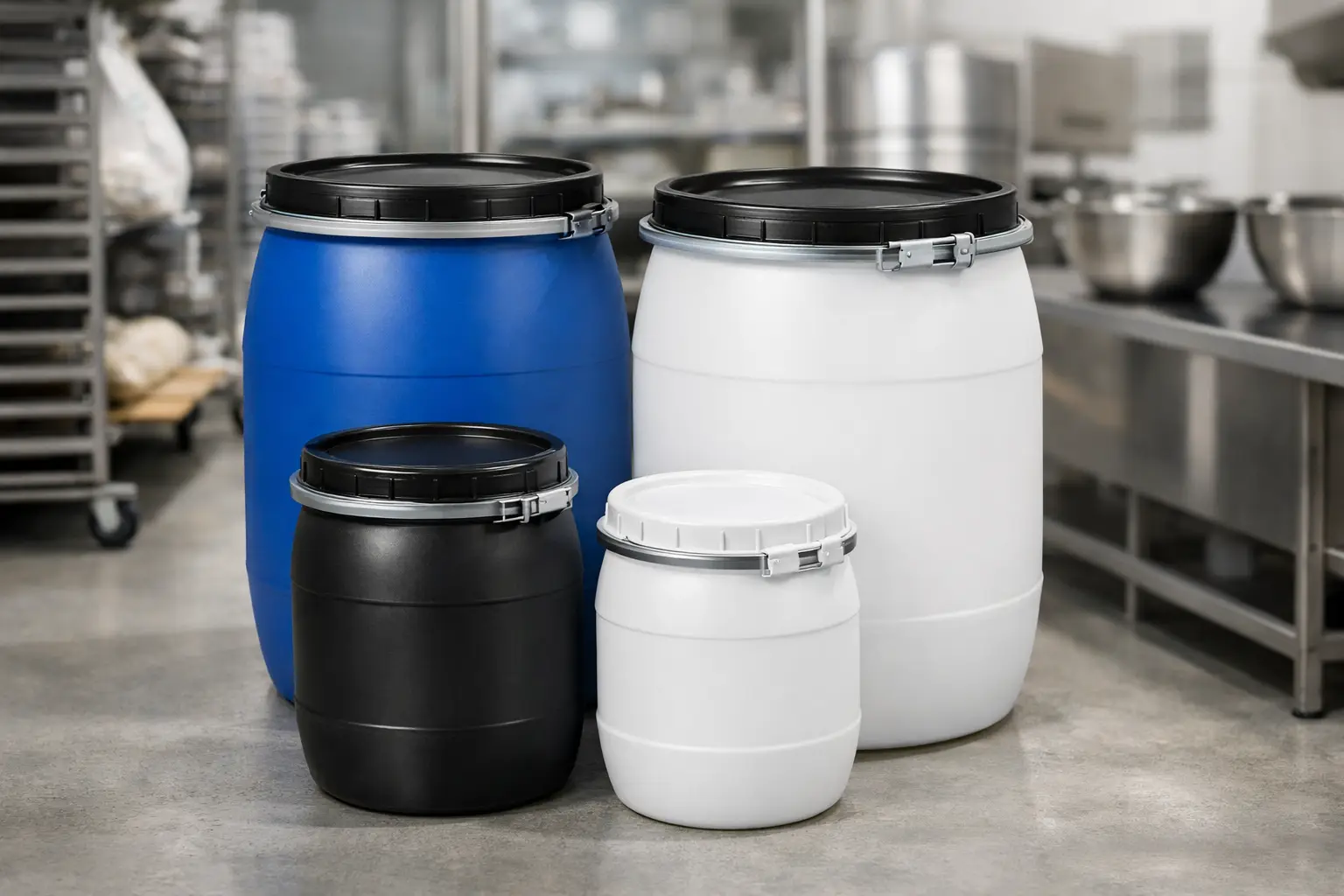
When a barrel is used for raw materials, brine, sauces, oil, or dry cargo, it’s not enough for it to simply “fit.” It must protect the contents, close properly, and withstand daily professional use. That’s why food barrels with lids are a fundamental choice for businesses seeking safe storage, hygienic handling, and more controlled transport.
In the food industry, the choice of the right container directly impacts both product quality and operational efficiency. An unsuitable barrel can create problems with cleaning, stacking, traceability, and handling. Conversely, a barrel suitable for food, with the correct lid and appropriate capacity, reduces operational risk and facilitates daily workflow.
What Food Barrels with Lids Should Offer
The first criterion is suitability for food contact. This means that the construction material must be appropriate for the specific use and meet relevant specifications. In practice, professionals usually opt for plastic barrels made of HDPE, as they offer good chemical resistance, low weight, and reliable performance in demanding warehouse or production environments.
The second criterion is the closure. The lid is not a simple detail. It determines protection from dust, moisture, external contaminants, and unwanted leaks. In applications with liquid or semi-liquid products, the quality of the lid’s fit plays a crucial role. For solid foods or raw materials, proper closure helps maintain cleanliness and reduce losses during handling.
Equally important is mechanical strength. A barrel used in a food processing plant, production unit, or distribution center must withstand frequent movements, loading, unloading, and storage. Here, theoretical capacity alone is not enough. The strength of the walls, the stability of the shape, and the container’s behavior when fully loaded need to be considered.
Selection by Product and Application
The same barrel does not suit every food product. The correct choice depends on the contents, frequency of use, and handling method.
For liquid foods, such as juices, oil, syrups, or brines, special attention is required for sealing and ease of filling and emptying. If the product is frequently moved internally within the facility, a barrel that closes securely but also opens practically, without delaying the production process, is beneficial.
For semi-liquid products, such as purees, sauces, or marinades, ease of cleaning is often as important as capacity. A removable lid with a wide opening facilitates inspection, access, and removal of residues. This is valuable not only for hygiene but also for reducing time during batch changes.
For solid raw materials or dry foods, such as olives, dried products, powders, or granular materials, protection from environmental factors and proper stacking are paramount. In these cases, the lid must fit securely, and the barrel body must remain reliable even when the contents are heavy.
Capacity and Ergonomics in Practice
Larger capacity does not always mean a better choice. A barrel capable of holding more product may reduce the number of containers, but it can make movement, emptying, and cleaning more difficult. On the other hand, too small a capacity increases the number of items the business has to manage and burdens storage space.
The right decision depends on the workflow. If the product is consumed quickly in production, a capacity that balances sufficiency with easy handling is often advantageous. If use is partial or in small batches, more barrels of smaller volume might be preferable for better control and less exposure of the contents.
Ergonomics also have a practical cost. Handles, shape, opening diameter, and overall weight when the barrel is full affect handling time and personnel safety. In a professional environment, these are not secondary points. They are directly linked to efficiency, fewer damages, and safer internal movement.
Lid, Sealing, and Protection Level
Removable Lid or More Controlled Closure
The type of lid should be chosen based on the application. A removable lid with a perimeter closure is particularly practical when frequent access to the contents is required. It facilitates filling, sampling, cleaning, and reuse.
However, if the product is handled more intensely or protection against leakage is a critical factor, increased attention is needed to how the lid is secured. The goal is not just for it to close, but to remain stable during transport, lifting, and temporary storage.
When Greater Attention to Sealing is Needed
Sealing becomes more important when the contents are liquid, when there are temperature fluctuations, or when barrels are frequently moved. Even small product losses can create hygiene, cleanliness, and safety problems in the workplace.
In such applications, the buyer should not rely solely on the general product description. They need to examine the type of closure, compatibility with the contents, and whether the container is intended for static storage or also for transport.
Hygiene, Cleaning, and Reuse
In food businesses, the container must seamlessly integrate into hygiene procedures. This means internal surfaces that clean effectively, geometry that does not easily trap residues, and material that withstands repeated use without rapid degradation.
Reuse offers clear operational and economic benefits, provided it is done correctly. Not all barrels are suitable for the same level of repeated stress. If a unit frequently washes, refills, and returns containers to production, the quality of construction and the durability of the lid become more significant.
For the same reason, it is worth considering from the outset whether the barrel is intended for single use, multiple cycles, or a mixed application of storage and internal distribution. The wrong choice may seem economical at purchase but cost more in replacements, damages, and labor time.
Food Barrels with Lids and Compliance Requirements
Suitability for food must be clear and documented. For a procurement manager or unit administrator, this is a matter of compliance as well as daily operational safety. When the container is used in an organized professional environment, ambiguous choices create unnecessary risk.
If the barrel is also to be used for transport outside the facility, then additional checks are needed regarding the relevant specifications required by that specific application. Not all barrels serve the same purpose. Some are primarily suitable for storage, while others support more demanding handling.
This is where the value of a specialized supplier like Pack Markt lies. The professional buyer doesn’t just need a container of the right size. They need a clear understanding of suitability, usage level, capacity, durability, and practical application in their own environment.
How to Make the Right Choice Without Delays
In practice, the right choice begins with four simple questions: What product will go inside, how often will the barrel be opened, will it be moved when full, and how many use cycles must it support? These answers quickly clarify whether you need a larger opening, increased sealing, a more durable body, or a different capacity.
It is also worth considering the available space and storage method. A barrel that functions correctly at the product level may be completely inconvenient for stacking, transport by trolley, or placement on a pallet. The best choice is one that supports the entire flow, from receipt to use and repositioning.
When the decision is based on actual application and not just price or capacity, food barrels with lids deliver what every professional space needs: safety, cleanliness, durability, and a more predictable daily operation. Ultimately, this is what makes a procurement correct from the first time.
Leave a comment
Your email address will not be published. Required fields are marked *