


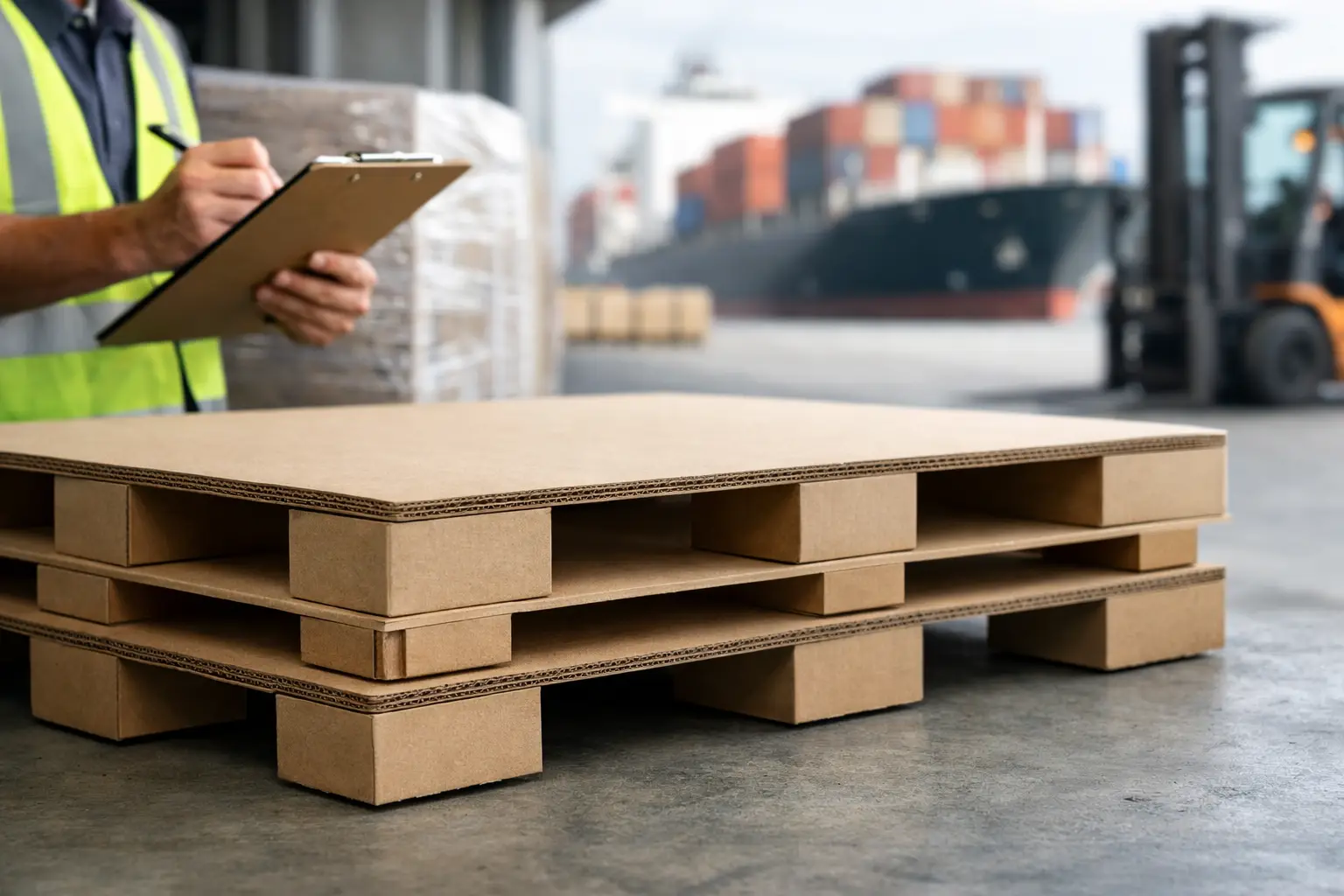
When shipping costs are calculated per kilogram and every additional customs check means delay, cardboard pallets for exports become a serious consideration. They are not a solution for every load, but in many international shipments, they offer a clean, lightweight, and functional advantage that directly impacts cost and logistics flow.
For a procurement or logistics manager, pallet selection is not just about purchase price. It affects the total weight of the shipment, compatibility with hygiene requirements, ease of handling in the warehouse, and the risk of failure during transport. This is precisely where cardboard pallets have a place, provided they are selected using the correct technical criteria.
When Cardboard Pallets for Exports Make Sense
Their primary value lies in their low tare weight. In air freight, courier pallets, or loads where transport costs are heavily impacted by weight, the difference can be substantial. A lighter pallet means more net product per shipment or lower overall cost.
A second advantage is the clean surface and the absence of nails, splinters, or wooden residues. This is practically significant in industries with increased cleanliness requirements, such as food, beverages, pharmaceuticals, secondary packaging, and selected industrial applications.
There is also a third point that is often overlooked. Cardboard pallets facilitate recycling at the end of use, especially when the recipient does not want to manage pallet returns or store empty transport materials. In one-way shipment export models, this is a significant factor.
What You Gain Compared to Other Pallet Types
Compared to wooden pallets, the main benefit is lower weight and a cleaner product image. Also, issues related to wood management in certain markets are avoided. Compared to plastic pallets, the advantage is usually lower cost for one-way shipments and easier recycling into the paper stream, where local conditions permit.
This does not mean they are a universally superior choice. If the load is very heavy, if storage occurs in high humidity conditions, or if the pallet will be intensively reused, paper is not always the right answer. The correct question is not which pallet is generally better, but which pallet is most suitable for the specific route, product, and handling method.
Technical Criteria to Check
Load-bearing capacity for static and dynamic loads
The first element is the actual strength of the pallet. The load differs when the pallet remains stationary on the floor versus when it is moved with a pallet jack or forklift. For exports, you need to request clear data for static load, dynamic load, and, if racking is involved, the corresponding limit on a shelf.
Many failures do not occur due to exceeding the nominal weight, but due to poor distribution. A compact and uniform load behaves differently from cartons with voids, asymmetrical pressure points, or shifting products. Therefore, knowing only the weight in kilograms is not enough. You also need to know how they ‘sit’ on the pallet.
Moisture Resistance and Transport Environment
The biggest reservation about cardboard pallets is obvious: how they perform in humidity. If the shipment passes through a port, remains outdoors, or is exposed to condensation during transport, special evaluation is required. There are constructions and treatments that improve resistance, but they do not negate the material’s limitations.
If the load is intended for container export with potential temperature fluctuations, protection should not rely solely on the pallet. Proper wrapping with stretch film, stabilization with corner protectors, and appropriate secondary packaging play an equally important role.
Dimensions and Compatibility with the Distribution Network
The pallet must fit not only the product but also the handling equipment. Check dimensions, pallet height, 2-way or 4-way entry, and compatibility with pallet jacks, ramps, automated systems, or conveyors, where applicable. A lightweight pallet that does not work correctly with warehouse equipment can create more problems than it solves.
In exports, space optimization is also important. Correct dimensions contribute to better utilization of containers or trucks and reduce empty spaces that increase the cost per unit of product.
Which Loads Are They Most Suitable For?
Cardboard pallets for exports are particularly useful for light to medium loads, packaged products with a stable base, displays, cartons, dry goods, and shipments where cleanliness and low weight are key requirements. They are also suitable for businesses that export frequently and want to reduce the total shipping weight without resorting to more expensive multi-use solutions.
For high-density products, heavy industrial items, liquids with increased total load, or applications with intense mechanical stress, more caution is needed. In these cases, plastic or wooden pallets often remain a safer choice.
What to Ask Your Supplier Before Purchasing
For professional use, general descriptions are not enough. You need clear technical data. Request load capacity, dimensions, pallet weight, construction method, usage conditions, and indications for moisture resistance. If the application concerns sensitive industries, also check any available information on suitability, material purity, and production processes.
If the shipment is recurring, it is worth conducting a test under real conditions. A small pilot use quickly reveals whether the pallet withstands stacking, loading, temperature changes, and the recipient’s behavior during unloading.
The True Cost Is Not Just the Unit Price
A common pitfall is comparing only at the unit purchase price level. In exports, correct cost calculation includes transport weight, potential damage, return management, the need for additional stabilization materials, and handling time in the warehouse.
A cardboard pallet may be more expensive than a simple low-quality solution, but yield a better overall result for the shipment. However, the opposite can also be true. If excessive reinforcement is needed to feel secure, or if the load has a high risk of deformation, then the theoretical benefit is lost in practice.
How They Integrate into More Efficient Logistics Practices
Businesses that seriously organize their exports do not view the pallet as an isolated material. They see it as part of a system that includes primary packaging, cartons, load stabilization, storage, loading, and final receipt. This is where an option’s true functionality becomes apparent.
That is why cardboard pallets perform best when combined with proper loading unit design. A good product base, correct stacking height, balanced center of gravity, and adequate wrapping make a difference. The pallet material is important, but the overall transport unit is what is ultimately judged on the road.
For businesses seeking solutions with commercial clarity and technical characteristics suitable for professional use, evaluation must be based on the application and not on general rules. This is also the safest way to reduce operational risk without compromising efficiency.
If you are considering cardboard pallets for exports, start with your load, not market trends. When the pallet truly fits the route, product, and handling conditions, it becomes a tool for savings, not a source of uncertainty.

Leave a comment
Your email address will not be published. Required fields are marked *