


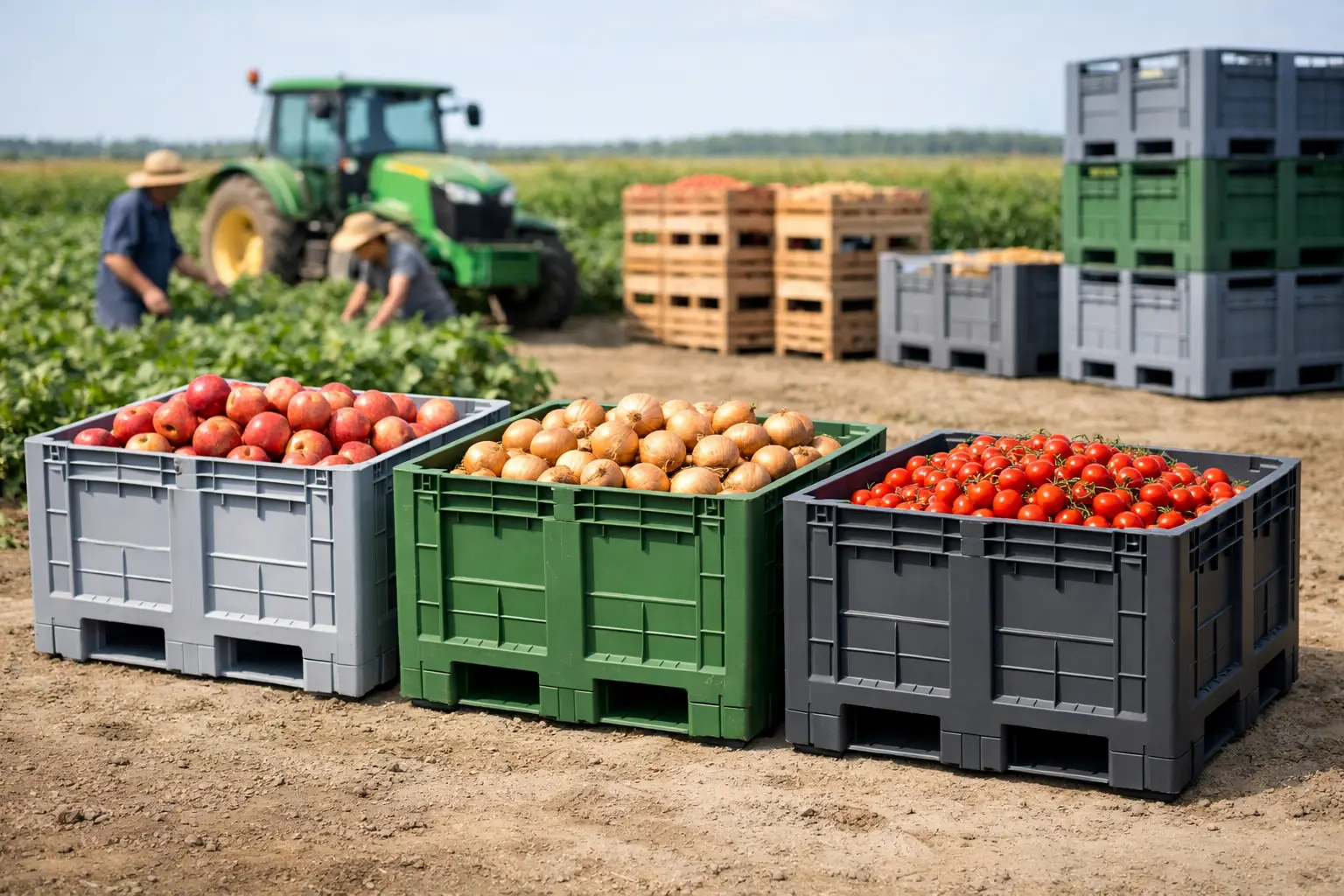
During harvest, the wrong box immediately becomes apparent. The product gets compressed, ventilation is insufficient, stacking loses stability, and transportation becomes slower and more expensive. That’s why agricultural pallet boxes are not just a simple storage choice. They are a critical part of the daily workflow, from the field and packing house to temporary storage and distribution.
For a professional producer, packer, or procurement manager, capacity is not the only concern. It’s whether the pallet box can withstand repeated use, if it’s easy to clean, if it’s suitable for food contact where required, and if it supports safe internal handling with a forklift or pallet truck. That’s where its true value is judged.
Why Agricultural Pallet Boxes Affect Costs
In agricultural logistics, many losses don’t stem from a major failure but from small, everyday wear and tear. An unsuitable box can cause damage to fruits and vegetables, uneven loading, difficulty in returning empty containers, or increased washing time. When these issues recur with every batch, operational costs rise without being immediately visible.
The right pallet box reduces product losses and stabilizes the workflow. It aids in safe stacking, optimizes warehouse and vehicle space utilization, and minimizes failures during loading. In fresh produce applications, this directly relates to the quality that reaches the customer.
However, there isn’t a single solution for everyone. Citrus harvesting has different requirements than managing table grapes, or the temporary storage of olives or root vegetables. The correct choice depends on the weight, the sensitivity of the load, the duration of stay inside the box, and the cleaning conditions.
What to Check in Agricultural Pallet Boxes
The first criterion is the construction material. Plastic pallet boxes usually excel in moisture resistance, ease of cleaning, and dimensional stability. For professional food use, it’s important to choose solutions suitable for relevant food contact, when the application requires it. This is not a typical detail but a matter of hygiene, compliance, and safe management.
The second is mechanical strength. The permissible load, resistance to dynamic and static stacking, and the behavior of the box when moved full many times a day must be examined. A box may seem adequate for static storage but show fatigue under intensive forklift use.
The third aspect is its geometry. The external dimensions must be compatible with pallets, shelving, loading areas, and transport vehicles. Equally important is the internal volume, as it determines whether the product will be placed securely or compressed. For agricultural products, a difference of a few centimeters can alter the behavior of the entire batch.
Perforated or Solid Walls
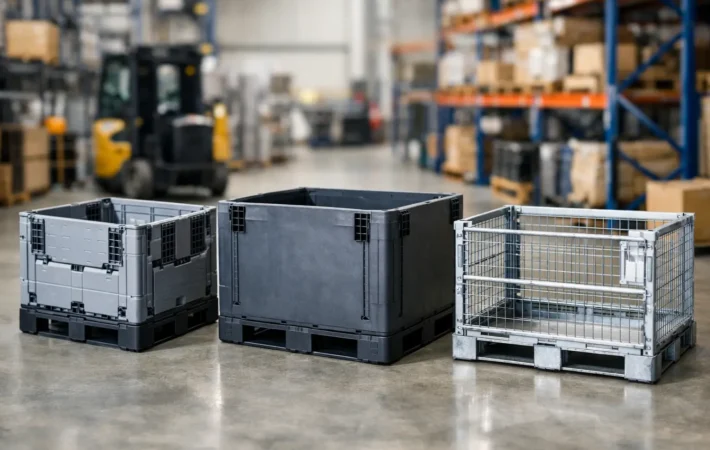
The choice between a perforated and a solid pallet box depends on the product and the process. Perforated walls aid ventilation and are often preferred for fresh produce that requires better air circulation. For fruits and vegetables, this can contribute to maintaining quality during temporary storage and transport.
Solid walls are more suitable where greater containment of small products, protection from external contaminants, or more controlled storage is required. They are not always better. If the product generates heat or moisture, the lack of adequate ventilation can become a disadvantage.
Feet or Skids
The base directly affects handling. Models with feet are practical for stacking and specific warehouse conditions, while models with skids often offer better stability and easier handling in automated or repetitive workflows. The equipment already used by the business plays a role here.
If handling is primarily done with forklifts on uneven floors or in loading/unloading yards, special attention is needed for the rigidity of the base. Conversely, in a controlled indoor environment, greater emphasis may be placed on optimizing space and the overall weight of the empty box.
Hygiene, Cleaning, and Reuse
In agri-food applications, cleaning is not a secondary issue. Residues of soil, juices, and organic matter burden the product and the process. A pallet box with smooth surfaces, proper drainage design, and resistance to frequent washing reduces time and resource consumption.
Reusability is also a key amortization factor. A quality pallet box may have a higher initial cost, but if it withstands cycles of use without cracks, warping, and stacking problems, the total cost per use becomes lower. For many businesses, this is more significant than the initial purchase price.
Choosing certified solutions for professional use also helps here. Pack Markt, for example, emphasizes solutions with technical suitability, durability, and clear product specialization, which is valuable when the buyer needs to decide quickly but without risk.
Common Mistakes in Selection
The most common mistake is selecting based solely on capacity. A large box does not necessarily mean a better solution. If the product is sensitive to pressure, excessive loading height can increase damage. This is especially true for fresh fruits whose commercial value depends on appearance.
A second mistake is ignoring the actual handling cycle. Different solutions are needed for field collection, temporary ripening or waiting, and internal transport to a packing house. In several cases, the correct answer is not a single type of box but a combination per stage.
A third mistake is underestimating return space. If pallet boxes are returned empty, the ability to stack or fold, where available, can significantly reduce costs. This is not critical in every operation, but it makes a difference on routes with frequent returns.
How to Choose Based on Application
For fresh fruits and vegetables, priority is given to ventilation, hygiene, and product protection from crushing. Durable plastic pallet boxes with perforated walls and a stable base are usually preferred for safe transport and storage.
For heavier or less sensitive products, such as certain root vegetables or industrial agricultural products, greater emphasis is placed on mechanical strength and loading capacity. In such cases, a more “robust” solution may be acceptable, provided it facilitates the cleaning and handling flow.
For facilities with strict hygiene requirements, ease of washing and food suitability are central criteria. For export businesses, standardization of dimensions, stacking stability, and consistency of the packaging medium in each shipment are more important.
The Right Purchase Is Not Just About Price
For agricultural pallet boxes, the lowest purchase price rarely provides a complete picture. What matters is the cost-to-lifespan ratio, handling safety, cleaning time, and product protection. If the box reduces damage, speeds up loading, and withstands repeated use, then it performs well operationally and commercially.
For the professional buyer, the safest approach is to start with the application, not the catalog. What product will go inside, how long will it stay, how will it be moved, how many times will it be washed, what weight will it bear, and in what environment will it be used? When these questions are clearly answered, the choice becomes quicker and much more accurate.
If pallet boxes are properly integrated into your operation, they will not just be another storage medium. They will become a tool that protects the product, supports productivity, and reduces daily operational risk.
Leave a comment
Your email address will not be published. Required fields are marked *