


When a chemical product leaks, the problem is not just material loss. It poses a risk to personnel, burdens the workspace, causes production delays, and incurs compliance costs. Therefore, choosing an IBC container for chemicals is not a simple purchase of a container; it is a decision concerning operational safety.
For professional applications, the correct IBC must simultaneously meet three criteria: chemical compatibility, mechanical strength, and certified suitability for transport and storage. If one of these is missing, the risk quickly increases, even if the tank appears suitable in practice.
What is an IBC Container for Chemicals?
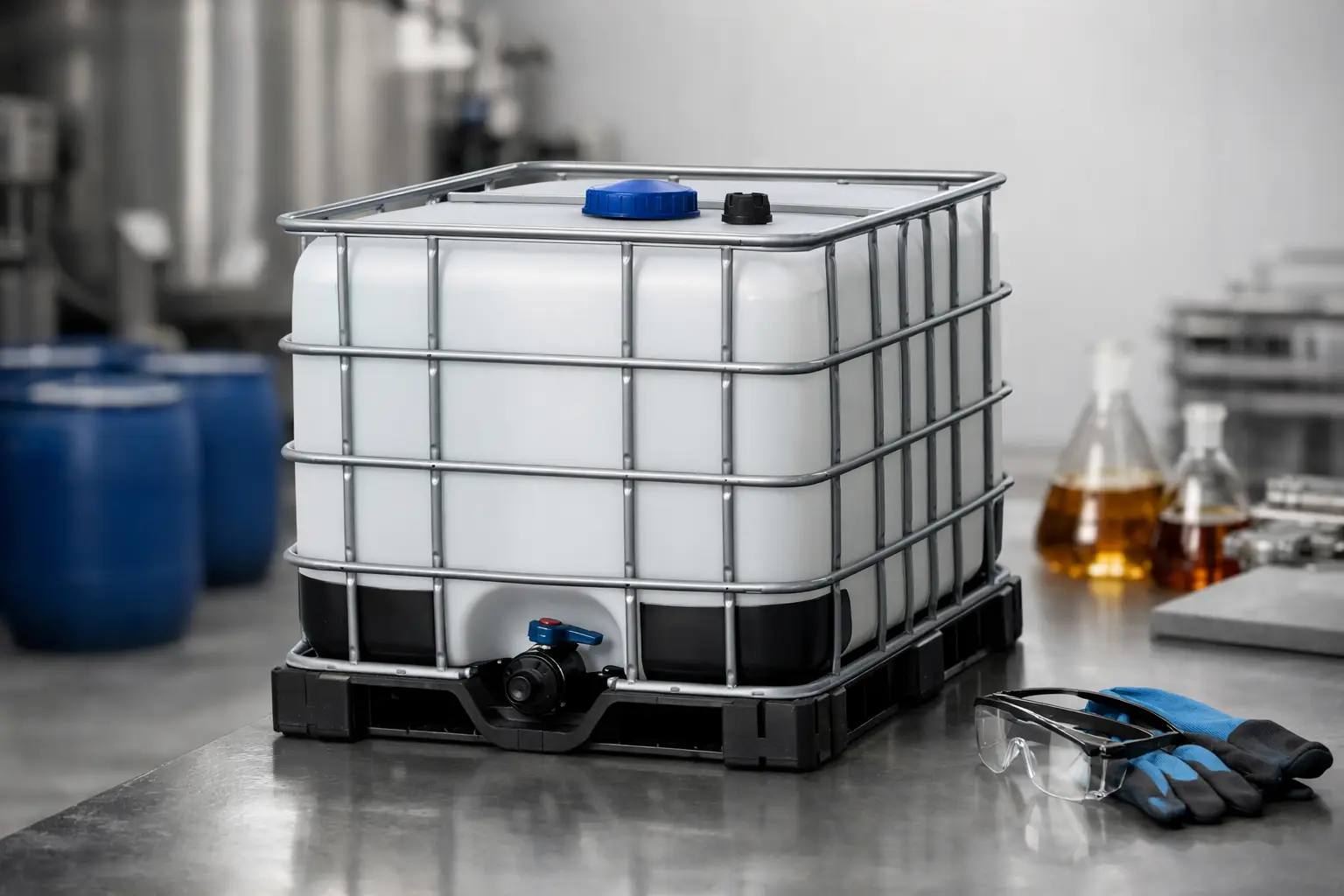
An IBC container for chemicals is a large-capacity industrial container, typically 600 to 1,000 liters, designed for the storage and internal movement or transport of liquid chemical products. Its basic structure consists of an inner vessel, usually made of HDPE, an external metal cage for protection, and a palletized base for easy handling with a pallet truck or forklift.
What differentiates it from a common container is that it is designed for professional use, with an emphasis on stability, stackability, and safe discharge. In warehouses, industrial units, chemical applications, and production lines, the IBC functions as a practical solution that reduces handling and improves the organization of material flows.
Why a General-Purpose IBC Is Not Enough
Not every IBC is suitable for chemicals. This is the first point that is often underestimated. A container may have the same capacity and similar external construction but differ significantly in compatibility with its contents, certification, and behavior in demanding environments.
Some chemicals affect the plastic container over time, causing alteration, hardening, swelling, or micro-cracks. Others require a special valve, a specific gasket, or increased resistance to temperature changes. If the application involves the transport of hazardous materials, then UN certification ceases to be optional and becomes a fundamental requirement.
Simply put, the right choice is not made based solely on liters or price. It is made based on the product that will fill the tank and the conditions under which it will be used.
IBC Container for Chemicals and Material Compatibility
Chemical compatibility is the first technical filter. The inner vessel of an IBC is usually made of high-density polyethylene (HDPE) because it offers good resistance to many chemicals, low weight, and practical management. However, HDPE does not react the same way to every substance.
Acids, alkalis, detergents, cleaning solutions, lubricants, additives, and specialized chemical preparations have different requirements. Not only the type of substance but also its concentration, storage duration, and temperature play a role. A container that performs well in short-term use may not be the right choice for long-term storage.
Equally important are the components. The discharge valve, gaskets, and lid must be compatible with the contents. In many cases, the weak point is not the body of the tank but the discharge system. This is where wear, leaks, or sealing problems most frequently occur.
The Importance of UN Certification
If the IBC is intended for the transport of hazardous chemicals, UN certification is a critical criterion. It is not just about compliance with an inspection or transport requirement. It indicates that the tank has been tested for specific stresses, such as dropping, pressure, stacking, and leak-tightness.
For the professional buyer, certification acts as a safeguard. It reduces operational risk, facilitates specification management, and allows for clearer matching of product and use. It does not mean that every certified IBC fits every chemical, but it does mean that the product has been evaluated against stricter criteria than a general storage tank.
If the use is exclusively internal and does not involve the transport of hazardous cargo, the need may differ. Even then, however, manufacturing quality and technical documentation remain essential selection criteria.
Construction, Base, and Durability in Daily Use
In an industrial environment, an IBC does not remain stationary. It is lifted, moved, stacked, emptied, and refilled. Therefore, mechanical strength is not a secondary characteristic.
The metal cage protects the inner container from impacts and deformations. The base, whether plastic, metal, or hybrid, affects stability, handling durability, and behavior over multiple use cycles. In environments with high handling intensity, the base is subjected to significant stress from lifting equipment and repeated loading.
The choice depends on the application. If the tank will primarily remain in a fixed position, other specifications suffice. If it constantly moves from warehouse to production and back again, increased strength is needed for the base, the cage, and the handling points. This is where the difference between an economical solution and a truly professional solution becomes apparent.
When to Choose a New vs. Reconditioned IBC
This is a matter that depends on the application. For chemical products, especially when there are strict requirements for purity, traceability, or certification, a new IBC container is usually the safest option. It reduces uncertainties regarding previous use and offers clearer control over specifications.
Reconditioned or reused IBCs may have a place in specific industrial applications, but not indiscriminately. If the chemical is sensitive, if there is a requirement for increased hygiene, or if corporate policy emphasizes maximum safety, cost savings should not outweigh the risk.
The correct decision here is not theoretical. It is linked to the type of liquid, internal quality policy, frequency of use, and the cost of a potential failure.
What to Check Before Purchase
A good commercial choice begins with the right questions. First, consider the chemical substance, its concentration, and the temperature of use. Then, check if the tank has the appropriate construction materials, the required certifications, and the correct discharge valve for your specific workflow.
Dimensions, compatibility with available space, stackability, and the equipment used in your warehouse are also important. An IBC may be technically excellent but functionally inconvenient if it does not fit your ramps, pallet trucks, or storage layout.
For many professional buyers, it is also crucial whether the supplier can support selection based on application rather than just a product code. This is where the value of a specialized partner like Pack Markt becomes evident, especially when the need combines storage, handling, and compliance.
Storage Conditions and Safe Handling
Even the appropriate IBC requires correct use. The bearing surface must be stable and level, filling must be within specifications, and the valve must be protected from impacts or accidental opening. For chemical products, content labeling and avoiding batch confusion are as important as the container itself.
If storage is outdoors, exposure to sun, thermal load, and environmental changes must be monitored. Certain chemicals and conditions require additional precautions, such as secondary containment or specific stacking rules. The right container reduces risk, but it does not replace the correct procedure.
The Right Choice Reduces Costs That Are Not Immediately Apparent
The apparent cost is the purchase price. The true cost, however, often lies elsewhere: in product losses, production delays, returns, handling failures, and potential compliance issues. A suitable IBC container for chemicals is not purchased merely to store liquid; it is purchased to support safe and stable operation.
That is why the best choice is usually the one that precisely fits your use, not simply the cheapest or most readily available. When the tank, certification, and application align, daily management becomes more predictable, and operational risk is reduced.
If you manage chemicals in production, warehousing, or transport, it is worth treating the IBC as a critical operational tool rather than a simple consumable container. This changes the quality of the choice from the very first order.
Leave a comment
Your email address will not be published. Required fields are marked *